
No Carbon Cost at Harvest
Peat is extracted by draining and cutting into peatlands — carbon sinks that have been sequestering carbon for millennia. That extraction process alone releases stored carbon and destroys the bog's ability to keep storing it.
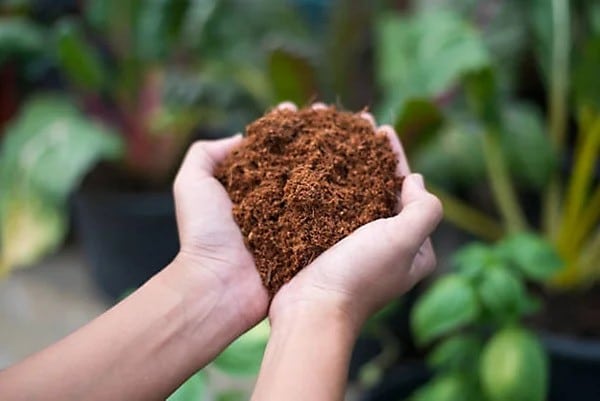
Coir doesn't have an extraction problem because it isn't extracted from a carbon sink at all. It's a byproduct of coconut farming: the husk that's left over once the coconut itself has been used for food, water, or oil. No bogs are drained, no peatlands are disturbed, and no additional extraction emissions are created to bring coir to market.

Eliminates Peat's Largest Emissions Source
Harvesting is only half of peat's carbon story. Once peat is used in a growing medium, it continues to decompose and release the carbon it had stored for thousands of years — a slow-motion emissions source that keeps adding up long after the bag is empty.
Coir doesn't carry that same decomposition penalty. Because it isn't a long-term carbon store to begin with, using it and letting it break down afterward doesn't release significant stored carbon back into the atmosphere. That single difference eliminates what is typically peat's largest source of lifecycle emissions.
Here's why that matters so much: once peat is dug up and exposed to air, microorganisms break it down far faster than they would in a waterlogged bog, releasing roughly 183–257 kg of CO₂-equivalent per cubic metre extracted — in the same range as driving a gasoline car 700–1,000 km. More than 80% of peat's total lifecycle emissions happen at this stage, not during mining or shipping. That means even fully electrified equipment and carbon-neutral transport wouldn't fix peat's carbon problem — the emissions are intrinsic to removing carbon-rich material from a wetland and letting it decompose. They can't be engineered out.
Up to 97% Lower Lifecycle Emissions
Put extraction and decomposition together, and the gap between coir and peat becomes hard to ignore. Across sourcing scenarios, coir generates only 3-32% of peat's total lifecycle carbon footprint — in other words, up to 97% lower emissions overall.
For growers and retailers thinking about Scope 3 targets, or gardeners who just want their hobby to line up with their values, that's not a marginal improvement. It's close to removing the carbon question from the equation entirely.
Outperforms Peat Under Every Scenario
The most convincing part of the comparison isn't the best case — it's the worst case. Even when coir is evaluated under its highest-emission scenario, it still comes in 84% below peat's lowest-emission scenario. There's no sourcing condition under which peat comes out ahead.
That's the difference between a product that's "better for the planet" as a marketing line and one that holds up under real scrutiny, scenario by scenario.
Better for the Garden, Better for the Planet

None of this works if the growing performance isn't there too — and it is. Coir holds more water, resists compaction, and supports strong root development, which is why growers keep switching and staying switched. The carbon case just makes the decision easier: a growing medium that performs as well or better than peat, without peat's extraction impact or decomposition penalty.
That's the promise behind everything we make: better for the garden, better for the planet. The lifecycle numbers are one more reason it's true.
Ready to make the switch?
Share:
COCO Coir Potting Mix for Vegetable Gardens
Guide to Choosing the Right Plants for COCO Coir